


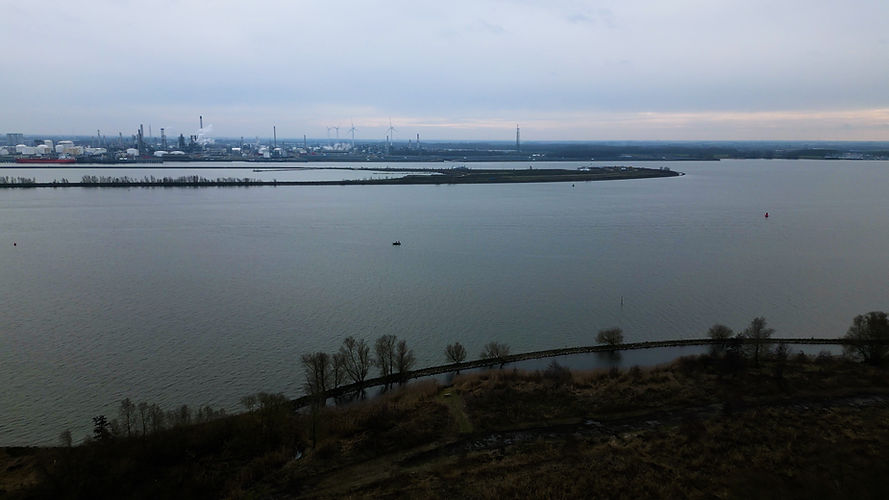
Predator Fishing on the Hollands Diep
I never approach the Hollands Diep with a fixed route of spots.
That simply does not work here.
Conditions – and especially the wind – determine which areas can realistically be fished. From there, things can become clear quickly, or it may take time. Sometimes a spot produces fish immediately, and then we stay. As long as fish are being caught, but also when bites are there without fish landing. Leaving fish to look for fish is never the rule here.
If there is no response from below at all – whether because a technique cannot be applied properly or because the fish simply are not active – the decision is straightforward: move on and start again elsewhere.
This is how a day develops. No stories about fish being trained, angling pressure, or that east wind automatically means poor fishing. No searching for “the right colour.” We make decisions and use everything
available to locate fish and reach them with lures.
I explain what I do and why I do it.
But I make no promises and invent no explanations afterwards.
The Hollands Diep itself shows what makes sense.
Anything that does not, we leave behind.


Why This Water Is So Demanding
The Hollands Diep is neither a classic lake nor a standard river.
It is a large, open system where current, water level, wind and shipping interact continuously.
That is what makes this water demanding.
And that is also why it is highly productive – especially for zander.
Zander rarely hold a fixed position here for long. Sometimes they stay within an area for a while, sometimes they become unreachable within the same day. That is not a mistake in approach, but a characteristic of this system.
In practice, this becomes very clear.
There are situations where fish are present but only react if presentation, speed and depth match precisely. In those moments, a targeted adjustment can make the difference.
There are also days when nothing happens. No bites, no feedback, even though much appears right. In those situations, this is not a technical problem but the reality of a water that cannot be controlled.
What matters here is not explanation but observation.
Something works – or it does not.
And if it does not, a decision has to be made.
That is fishing on the Hollands Diep.
Bycatch and Reality
Our focus is always on zander.
The Hollands Diep, however, is a large, open and very fish‑rich water, where other predators can appear at any moment.
Typical bycatch includes:
-
large perch
-
pike, often well over a metre
-
asp with extremely hard takes
-
and occasionally even catfish
None of these species are targeted when fishing the Hollands Diep. They are part of the water. Depending on the spot, the technique used and the always present element of chance – or luck – any of these fish can be caught.
The focus remains the same.
Anything additional is simply welcome.

My Approach on the Hollands Diep
I do not fish the Hollands Diep with a fixed plan.
I work with options.
At the start of the day, the goal is not to find “the right spot,” but to determine as quickly as possible what makes sense that day. Areas are fished, observed and evaluated. If there is feedback, we continue. If there is none, a decision is made.
During fishing, decisions are adjusted continuously. If fish are contacted but the response remains unclear, targeted changes are made – angle, speed or depth. Not based on hope, but to determine whether the spot still has potential.
If adjustments bring no feedback and conditions allow, the conclusion is clear. We move on and reset elsewhere. Not out of impatience, but because time spent on a non‑productive area is simply lost.
This is how a day takes shape.
Not from theory, but from observation.
I explain what I do and why I do it.
I offer no promises and no explanations after the fact.
The Hollands Diep cannot be planned.
It can only be worked carefully, with consistent decisions.

For Whom This Works – and for Whom It Does Not
This way of fishing suits anglers who do not mind giving a spot time. Sometimes it stays quiet, even when there are good reasons to remain. In those cases, we stay.
It fits if you are willing to keep fishing as long as there are signs of life – even if no fish are landed yet. Sonar marks, missed takes or individual contacts are reasons to keep fishing.
It fits less if you want to move on quickly after a few casts without a fish. Or if you expect a predictable structure to the day. That does not exist here. Conditions change constantly and require continuous adjustment.
This also means you sometimes lose. To the conditions. Or to the fish. The Hollands Diep can demand a lot and does not always give something back.
At the same time, it can surprise at any moment. Without warning and without plan. A spot that showed nothing earlier can suddenly be full of fish. Or a wind‑exposed area where casting is barely possible delivers an exceptional fish.
That is the Hollands Diep.
And that is what you sign up for.

Techniques – Tools, Not Concepts
On the Hollands Diep, different techniques are used. Which one comes into play is not a starting point, but a result of what is possible under the current conditions.
In practice, fishing usually alternates between casting, long‑lining and (LiveScope) vertical fishing. Sometimes a change is necessary due to wind, drift or depth. Sometimes we deliberately stay with one technique because it provides feedback.
What we never do is stick with a technique that clearly produces nothing.
A technique remains in use as long as it either catches fish or provides information about whether fish are reachable. Once that feedback disappears, the technique loses its purpose.
A technique is never a goal in itself.
It is a tool to determine where and whether fish can be reached.
And the technique that catches fish is the right technique at that moment.
Book Your Fishing trip on the Hollands Diep
Do you want to fish specifically for zander on one of the best waters in the Netherlands, together with someone who knows this system in detail? Then book your fishing trip with Lure Fishing Guide. Whether you come for hard zander bites, want to try for strong perch, or hope for something truly special like a metre‑plus pike or catfish – the Hollands Diep offers it all, and with the right approach you can experience days you will not soon forget.
With Thom Prüst, you do not fish a random lap. You fish with purpose, on spots that have potential at that moment, using techniques that have proven themselves on this water. You receive guidance that makes you more effective, equipment that fits, and an approach focused on results and experience.
This is your opportunity to experience the Hollands Diep as it is meant to be fished: precise, technical and with real possibilities for quality fish.


Big pike
out on the open
