


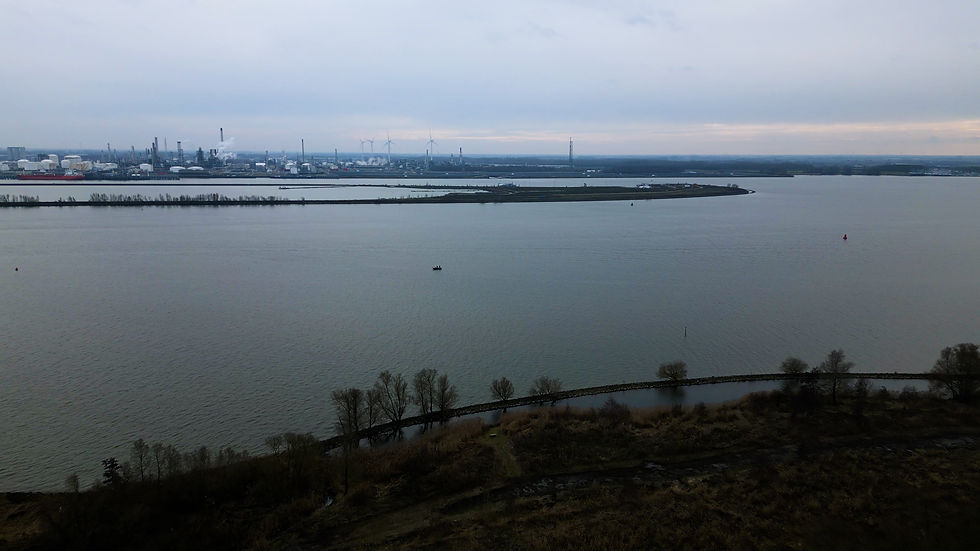
Zander Fishing in the Netherlands – Complete Guide to Hollands Diep
A technical, honest and experience‑based guide for international anglers
Hollands Diep: A Logical Water That Rewards Anglers Who Understand Structure
Hollands Diep is one of the most reliable zander waters in the Netherlands because it behaves logically. It is not a water full of mythical hotspots or unpredictable fish. It is a system built on depth, bottom transitions and long structural lines that shape where zander hold and how they feed.
Anglers who understand these elements consistently catch fish, while those who drift aimlessly often spend hours fishing in empty water. Hollands Diep is not easy, but it is fair: if you fish with control and intention, the water makes sense — and once it makes sense, it becomes one of the most rewarding zander waters in Europe.
For a complete overview of predator fishing in the Netherlands, you can read the main guide here.
How Zander Behave on Hollands Diep
You do not catch zander on Hollands Diep because you know a list of spots. You catch zander because you understand why the fish are in a certain place. On this water everything shifts: baitfish, current, drift, depth, pressure. A slope that was full of fish yesterday can be completely empty today. A flat area that normally produces nothing can suddenly become interesting when baitfish hold there for a short period.
The foundation is that zander on Hollands Diep always look for transitions: slopes, edges, depressions, hard patches, shell beds. These are places where current breaks, where baitfish gather and where zander can hunt efficiently. But even these places are not “fixed.” They only become relevant when the conditions line up. A slope is not a spot — it is a potential spot, depending on how the water behaves at that moment.
What many anglers underestimate is that zander on Hollands Diep respond primarily to control. If you cannot fish your shad cleanly, you cannot work the structure properly. If your drift is too fast or too messy, you drift past the fish. And if you fish too light, you lose contact and no longer know what your shad is doing. On big water, control is more important than finesse. You must feel where you are, how your shad moves and how your drift runs across the slope. That is where the information is.
In short: zander fishing on Hollands Diep is not “spot fishing.” It is reading the water. Understanding how the slope runs, how your drift moves across the structure, how your shad behaves and when a zone is “on.” Anglers who master this no longer fish by chance — and they do not need hotspots.
If you are also interested in pike fishing in the region, the Biesbosch guide gives a clear picture of what to expect.
The Best Techniques for Zander on Hollands Diep
On Hollands Diep many techniques work “in theory,” but in practice everything revolves around control. Not finesse, not tricks, but the way you present your shad in conditions that constantly change. Vertical jigging, longlining and casting are not styles you choose at random — they are methods to keep your lure in the strike zone for as long as possible.
Vertical Jigging — Only Useful When Conditions Allow It
Vertical jigging on Hollands Diep only works when you are truly on top of the fish and when conditions are calm enough to keep your shad directly under the boat. On days with too much current or too much wind, vertical jigging simply becomes unusable. You lose control, your line angle drifts away and you fish past the fish.
When conditions do allow it, vertical jigging is an efficient way to target fish on compact schools or on zones where you know exactly what lies beneath you. But it is not a technique for searching water — it is a precision technique.
Longlining (Diagonal Fishing) — The Most Effective and Most Demanding Technique
Longlining is the most effective technique on Hollands Diep, but also the one that demands the most technically from the angler.
It is not a finesse technique. It is a method that keeps your shad in the strike zone for as long as possible while covering hundreds of metres of water in a single drift. The biggest problem for most anglers is simple: it is difficult to present your shad just above the bottom when fishing deep water with wind and current. And that is exactly where things almost always go wrong.
Fishing too high is the most common mistake. You think you are fishing correctly, but your shad is simply hanging far above the bottom. Only a zander that is actively hunting will come up to take it — but those are not the fish that matter. You will catch the active ones anyway. The skill lies in catching the fish that are not hunting, and you only catch those when your shad passes right in front of their nose. And where is that most likely to happen? Just above the bottom — nowhere else.
The good news: this can be learned.
And once you master it, an entirely new world opens up.
And yes — it is absolutely possible: you can feel a zander bite 30 metres behind the boat, in 10 metres of water.
But only if you use the right gear and understand how drift, line angle and weight work together.
Longlining is the technique that allows you to read Hollands Diep — and catch fish consistently.
Casting (Jigging) — The Most Spectacular Method
Casting for zander (jigging) is the most spectacular way to fish Hollands Diep.
Conditions must allow it — with too much wind it becomes difficult to fish your shad cleanly and hit the slope correctly — but when it works, it is pure adrenaline.
A bite at distance, when you let your shad hang against a slope, is indescribable.
You feel the strike not only in your rod, but through your entire body.
It is the technique that gives you the most direct contact with both the structure and the fish.
Casting is ideal when zander are actively hunting, when you are fishing clear edges or when you want to cover zones that cannot be longlined effectively.
Depth and Structure on Hollands Diep
Zander on Hollands Diep do not follow fixed patterns. They respond to structure, current and depth differences — not to the calendar. That is why rules like “deep in winter” or “shallow in summer” simply do not exist. What you do see is that certain zones are often logical, but never guaranteed.
Depth — Always Determined by the Situation
Zander are not “always deep” or “always shallow.” In practice, they are often found near places where deep and shallow water lie close together. These are zones where current changes, where the water “works,” and where more happens in general. A steep slope is usually better than a very gradual transition, because it creates more dynamics.
But it is not a law.
Sometimes zander hold in places that theoretically offer nothing: ten metres deep, soft bottom, no transition, no logic. Why? No idea. That is part of big water. You cannot explain everything.
What does often hold true: areas where deep and shallow lie close together produce fish most consistently. Not because there are “routes,” but because zander can position themselves easily — on top of the shallow, against the slope, or just on the deeper side. Where exactly? That changes day by day.
Structure — The Most Reliable Factor
Structure is the most reliable indicator on Hollands Diep. Not because these places are “hotspots,” but because zander prefer to hold near transitions:
-
deep ↔ shallow
-
hard ↔ soft
-
slope ↔ flat
But even that is not a guarantee.
It is a direction — not a rule.
Tackle That Works on Hollands Diep
Fishing Hollands Diep revolves around one thing: contact. And you only get contact when the entire combination is correct: rod, weight, line and shad.
No single component is more important than the others. The whole system must give you immediate feedback about what is happening underwater: where your shad is, how it reacts, whether it rises, whether you are fishing against a slope, or whether that last tap was a bite.
A rod must transmit your shad directly, without delay and without damping. From the boat, relatively short rods work best. The ideal length is somewhere between 2.00 and 2.15 metres. Around 2.00 metres gives maximum control for vertical jigging; around 2.15 metres works slightly better for casting. But within that range, one does not exclude the other. What matters is that the rod is fast and crisp enough to fish 20–30 grams without effort and to let you feel exactly what your shad is doing — high, low, slope, bottom, drift, bite.
The line is just as important.
Braided, thin, smooth, preferably with a PE coating to reduce resistance. A maximum of 0.10 mm, otherwise you will not reach the bottom due to wind and current pressure.
The reason we fish braided line is simple: no stretch. Without stretch, information comes through instantly. With stretch, you cannot feel when your shad hits the bottom, when it rises, or when a fish bites.
Fluorocarbon has nothing to do with invisibility. It prevents your main line from being cut by mussels or stones, and again: no stretch, direct feedback.
Weight determines whether you can control your shad at all. Too light means no contact, and therefore you are fishing on luck — and luck does not catch zander.
Too heavy is never ideal, but always usable. With too heavy you know where you are and you can correct. With too light you know nothing. That is why on Hollands Diep the rule is simple: better too heavy than too light.
The perfect height is always the same: five to ten centimetres above the bottom. You must be able to keep your shad there, regardless of depth, current or wind. If you cannot do that, nothing else matters.
Shads must run stable and give clear feedback. Tail shape is mechanics, not magic.
A paddle tail creates more pressure, helps you lift off the bottom and keeps your shad stable in the strike zone. But in strong current or too much water pressure, a paddle tail can push your shad upward. Then you need a V‑tail or pintail: less pressure, easier to return to the bottom, more control in current.
The practical rule is simple:
If you cannot lift off the bottom → paddle tail.
If you cannot get back to the bottom → V‑tail or pintail.
Colour does not change height, drift, stability or contact. But colour influences you. If you believe in a colour, you fish tighter, more focused and more consistently. The colour does not catch — you catch because you fish better.
Tackle is not a collection of separate choices.
It is one system that must give you direct information.
If that system is correct, you have control.
And control catches zander — not luck.
Technique
Technique on Hollands Diep is not about tricks or fancy movements. It is about one thing: keeping your shad at the correct height and receiving constant information about what it is doing. Everything serves that single goal: keeping your shad five to ten centimetres above the bottom, stable, regardless of depth, wind or current. If you can do that, you will catch fish. If you cannot, you can still catch fish — but it becomes much harder.
Vertical jigging, longlining and casting are completely different styles, but in reality you are always trying to execute the same principle: getting continuous feedback from your shad so you can keep it in the strike zone for as long as possible. The shad must remain in that zone — five to ten centimetres above the bottom — for as long as possible. You want to feel continuously, by tapping the bottom now and then, whether you are still in the right place. Your setup determines whether you can feel that at all. This is not guessing or relying on luck — it is controlled fishing.
With vertical jigging you work directly under the boat, and in theory you can keep your shad in the strike zone easily. In practice, current and wind push your shad away from the boat quickly, especially in deeper water, which makes vertical jigging far more difficult than it appears.
Longlining follows the same principle, but with much more line out. Because of the longer angle at which you fish, you can — when executed correctly — stay in the strike zone extremely efficiently and for a very long time across large areas. The downside: technically very demanding.
Casting follows the same logic, but you guide your shad through the strike zone with your rod. You cast, let it sink to the bottom, and by lifting your rod you bring your shad into the strike zone where you try to keep it suspended, waiting for that explosive bite.
You must always know where you are: high, low, slope, flat, hard bottom, soft bottom. If you cannot feel that, you are fishing on luck — and luck does not catch zander.
Those who cannot feel, fish on luck.
Those who can feel, fish with control.
And control catches zander.
Common Mistakes
Most anglers do not make mistakes because they are in the wrong place. They make mistakes because they lack control. They do not feel what their shad is doing, they do not know where it is, and as a result they are fishing on luck. And luck does not catch fish.
A major mistake is tackle. Bad tackle, the wrong tackle, too soft, too heavy, too parabolic — it makes control impossible. If your rod dampens all information so you cannot even feel when you hit the bottom, or if a thick line with a swivel‑tied leader is pushed away so hard that your shad never reaches the bottom, then you simply cannot feel where you are. You are not fishing with control — you are fishing on luck. And with luck you might catch something once in a while, but you will never be consistent.
This leads directly to the next mistake: fishing without information. People think they are fishing because their shad is in the water, but they have no idea whether it is high, low, hovering somewhere in between, or already metres out of the strike zone. They do not tap the bottom, they do not correct, and they do not notice when their shad drifts away. But that is not a conscious choice — it is the direct result of tackle that does not transmit information. Without information you cannot maintain height, and without height you are not in the zone where zander feed.
Many anglers also fish too light. They are afraid of fishing “too heavy,” but fishing too light is the real problem. If you fish too light, you lose contact, you lose height, you lose information. Your shad starts to float, you no longer feel the bottom, and you are essentially fishing blind. Fishing too heavy is rarely an issue; fishing too light is almost always a disaster.
Another common mistake is switching too quickly. New colour, different shad, different brand, different size — everything is changed except the one thing that actually matters: making sure you can fish your shad with control. If you can fish the shad that is already on your line with control, then the brand, shape or colour no longer matter. Switching only makes sense if it gives you control back. And once you have that control, you simply choose a colour you trust, because that is what makes you fish best.
And then there is the mistake almost everyone makes: thinking that things are “probably fine.” Thinking the shad is “roughly” at the right height. Thinking you are “more or less” in the right area. Thinking you “kind of” feel what is happening. But “roughly” is not enough. Zander is not a fish you catch by hoping things are correct. You must know.
Those who cannot feel, fish on luck.
Those who can feel, fish with control.
And control catches zander.
Access, Safety and Regulations for Visiting Anglers
Hollands Diep is accessible, but it is not a water to underestimate. A VISpas is required, and visiting anglers should familiarise themselves with local regulations and closed zones.
Safety must always come first. The water is large, open and exposed to wind, which can create dangerous conditions quickly. Drift speed, boat control and awareness of shipping lanes are essential.
Many visiting anglers underestimate how quickly conditions can change here, and how much influence wind and drift have on presentation. Wearing a life jacket is not optional.
Hollands Diep rewards respect; treat it casually and it will punish you. Approach it with awareness and preparation, and it becomes one of the most rewarding zander waters in Europe.
Realistic Expectations: What a Good Day on Hollands Diep Looks Like
A good day on Hollands Diep is not measured in dozens of fish, but in consistent bites, quality fish and the satisfaction of understanding the system.
The size distribution is strong, with many fish between 45 and 65 centimetres, regular catches above 70 and occasional trophies.
Seasonal peaks are clear:
-
autumn offers the most aggressive feeding,
-
winter brings the biggest concentrations,
-
summer is dynamic and bait‑driven,
-
and spring is transitional but productive.
Hollands Diep is not a water that gives away fish easily, but it is a water that rewards anglers who fish with intention.
For broader context on techniques, waters and species across the country, the main predator fishing guide is a useful next step.
Zander fishing on Hollands Diep is not about secrets. It is not a trick, not a colour and not a lure. It is control — control over your shad, your tackle and how you adapt to the conditions.
Master that and you will catch fish.
Fail to do so and you are fishing on luck.
And luck is not a strategy.
